
Over the past two days I have been playing with another small practice pattern. I call it the agent-own loop harness.
The name came out of using OpenSpec. OpenSpec is a lightweight spec-driven development framework for AI coding assistants [1]. Its own docs frame the core job as helping a human and an AI coding assistant agree on what to build before code is written [2]. After initialization, that agreement becomes concrete project structure: long-lived specs, proposed changes, proposals, delta specs, design notes, and implementation tasks [2].
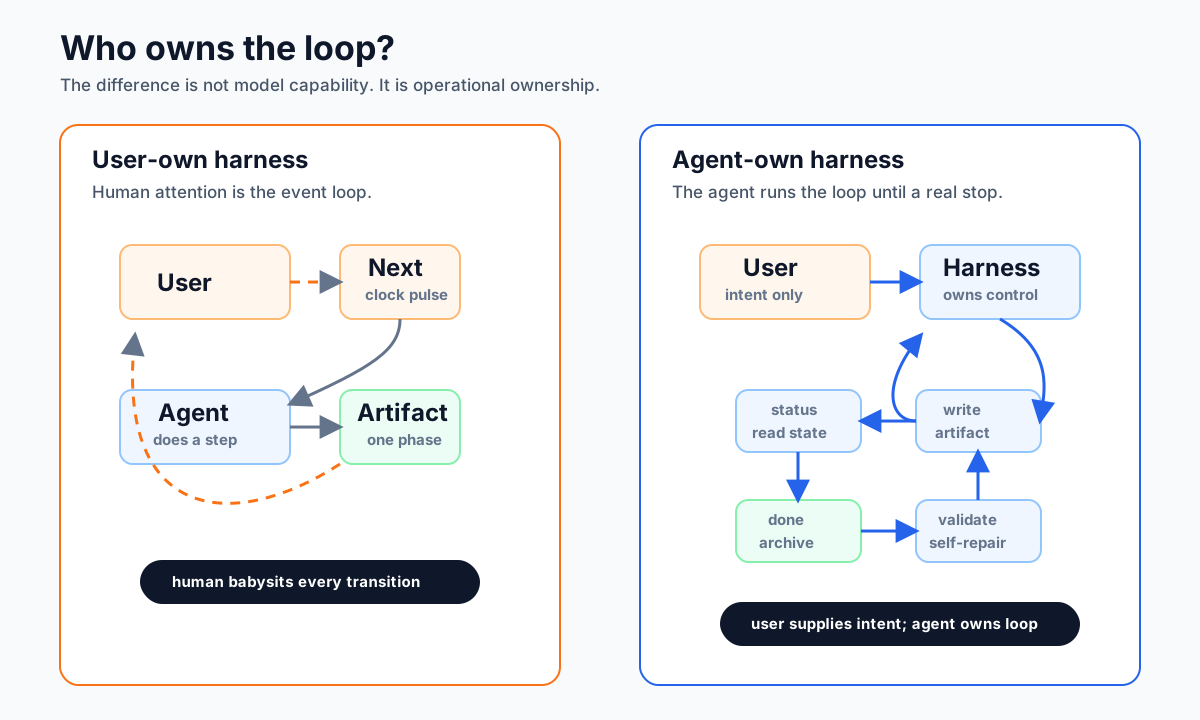
That structure is useful, but the default usage pattern can feel strangely attended. A person describes the desired change, the agent writes a proposal, then the system asks for the next step. The agent writes the specs, then the person says next. The agent writes the design, then the person says next. The agent writes the tasks, then the person says next again.
That is not really an autonomous loop. It is a user-owned loop with an agent inside it.
The human is not contributing much domain judgment at every step. In the boring middle of the process, the human is mostly acting as a clock pulse. The user is there to say “continue”, to pick the obvious active change, to approve a non-controversial next artifact, or to tell the agent to run validation after the process itself has already made validation the next required move.
That is the irritating part: the workflow is already procedural enough for an agent to run, but it is still packaged as if a human has to stand beside it.
So I built a no-human-in-the-loop version.
The core observation is simple. OpenSpec’s slash-command flow is not magic. It
is a set of procedural scripts for an agent. Underneath it, the CLI already
exposes the useful machine surfaces. The official docs even separate
non-interactive setup from attended setup through openspec init --tools ...,
which is exactly the kind of affordance an unattended loop needs [3]:
statustells the agent which artifact is ready, blocked, or done.instructionstells the agent what to read, what to write, and where to write it.validate --strictgives the agent a correction oracle.archive -ycloses the loop without waiting for a confirmation prompt.
Once those pieces are treated as a state machine, the person does not need to stand in the middle saying next. The agent can own the loop:
- Derive the change name from the user’s wish.
- Create the OpenSpec change.
- Read the state.
- Generate the ready artifact.
- Re-read the state.
- Validate.
- Implement the tasks.
- Mark tasks done as work is completed.
- Validate again.
- Archive the change.
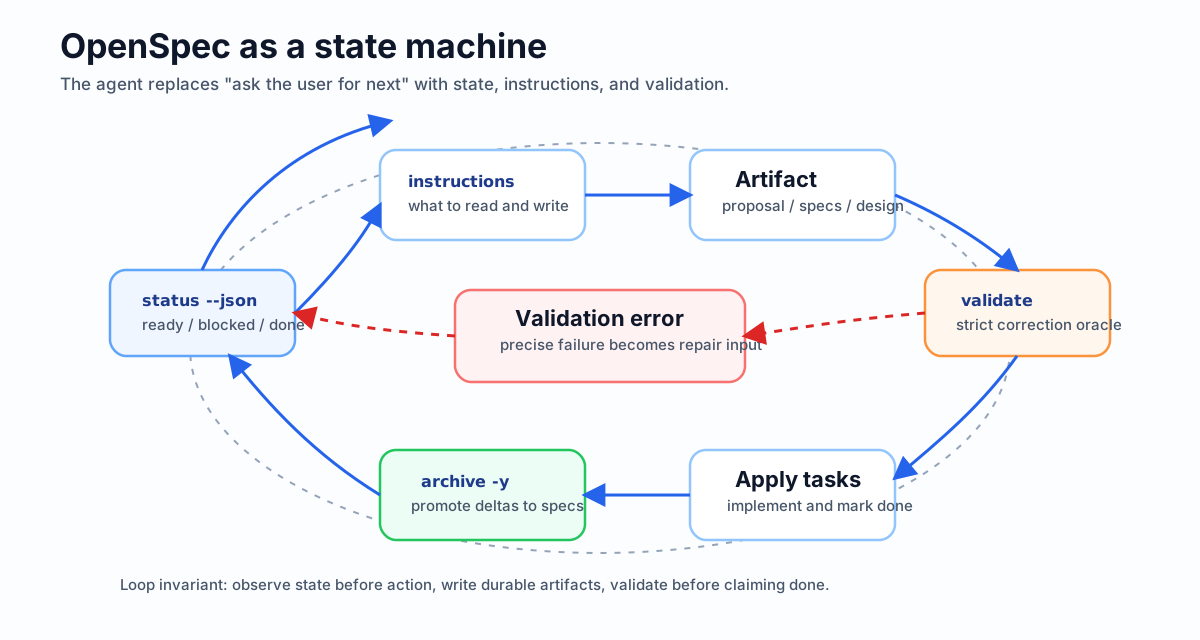
The user says what they want. The agent maintains the spec-driven development loop.
That shift sounds small, but it changes the shape of the product. In the attended version, the user is still the harness owner. The user holds the workflow in their head, knows the next command, resolves the pause, and restarts the process whenever it stops. The agent is powerful, but it is still being pulled through a human-operated machine.
In the agent-own version, the loop becomes part of the agent’s operating body. The harness tells the agent how to observe state, choose the next legal move, write durable artifacts, test its own work, and close the change. The human is not removed from intent or accountability. The human is removed from the low-value attendance layer.
That is the distinction I now care about:
User-own harness: the human operates the loop, and the agent performs steps.
Agent-own harness: the agent operates the loop, and the human supplies intent.
OpenSpec is a good example because the shape is so explicit. It already has proposal, specs, design, tasks, apply, validation, and archive. It already has machine-readable state. It already has precise validation failures that can be used for self-correction. The missing move is not a new planning theory. The missing move is to stop treating procedural agent instructions as human UX.
This also explains why some “agent workflows” feel heavier than they should. They are often built as user-owned harnesses. The system gives the user a beautiful sequence of buttons, commands, and checkpoints, but the user is still the scheduler. The agent may be writing code, opening files, running tests, and repairing failures, but the user’s attention is still the event loop.
That will not last.
Complex attended agent operation modes will keep folding inward. Anything that is deterministic enough to be scripted, stateful enough to be inspected, and recoverable enough to be validated is a candidate to move from user-owned harness to agent-owned harness. The person should not need to babysit a loop whose next state is already machine-readable.
The same pattern shows up outside OpenSpec. A coding agent should not need a person to remind it to inspect git status before editing. A deployment agent should not need a person to say “check the logs now” after a failed rollout. A research agent should not need a person to say “compare the sources” when source conflict is already visible in the evidence table. These are harness behaviors. At first they are explicit procedures. Then they become agent-owned loops.
Eventually, some of them may become model intuition.
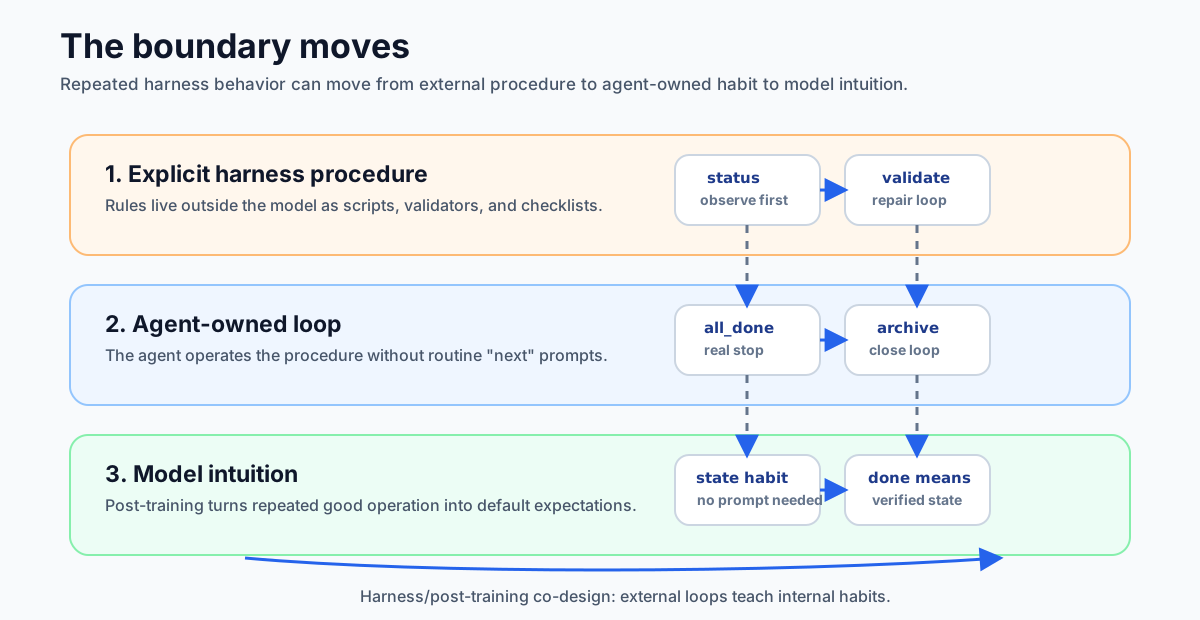
That is the interesting long-term direction: harness/post-training co-design. Today, a harness makes an agent behave better by surrounding the model with state machines, tools, validators, memory, and recovery rules. Tomorrow, the best repeated harness patterns can become training data, evaluation targets, and eventually something closer to default behavior. The harness teaches the model what good operation feels like. Post-training makes some of that operation feel native.
That does not mean the harness disappears. It means the boundary moves.
Early versions of a capability often live outside the model as explicit scaffolding. The harness says: read status, follow dependencies, write the next artifact, validate strictly, repair the named failure, continue. After enough exposure, the model may begin to internalize the rhythm. It starts to expect state before action, durable artifacts before implementation, validation before claiming done, and archival after completion.
The external loop becomes an internal habit.
This is why I think “agent-own loop harness” is a useful phrase. It names the middle layer between a human-driven workflow and a model that simply knows how to conduct itself. It is not just automation. It is a transfer of operational ownership.
I packaged this specific OpenSpec loop as a small reusable skill:
openspec-agent-sdd [4]. The repository is intentionally tiny:
one SKILL.md file with the operational loop, plus a README and license. That
shape matters. The point is not to create another framework around OpenSpec,
but to preserve the agent procedure in the smallest shareable unit: state
inspection, artifact generation, strict validation, task application, and
non-interactive archive.
The user should be able to make a wish:
I need this feature.
I need this post.
I need this investigation.
Then the agent should drive the appropriate loop until it reaches a real stop: completed, validated, archived, or genuinely blocked.
No ceremony. No “next” button as a human obligation. No person standing inside the event loop.
Just intent at the boundary, and an agent-owned harness doing the work.